Digital Trust Research — What I Found When Psychology Met Network Science
Research Links
- 📄 ACM Publication - The full research paper with detailed methodology and results
- 👤 Author Profile - ORCID academic profile and publication history
- 🎓 PhD Thesis - Complete doctoral research on Online Social Networks of Needs
The Question That Started It All
Working in tech, you see a lot of assumptions about how online communities work. Network effects, social graphs, algorithmic recommendations—we build systems based on ideas about how people connect and trust each other digitally. But I kept wondering: are we actually measuring the right things?
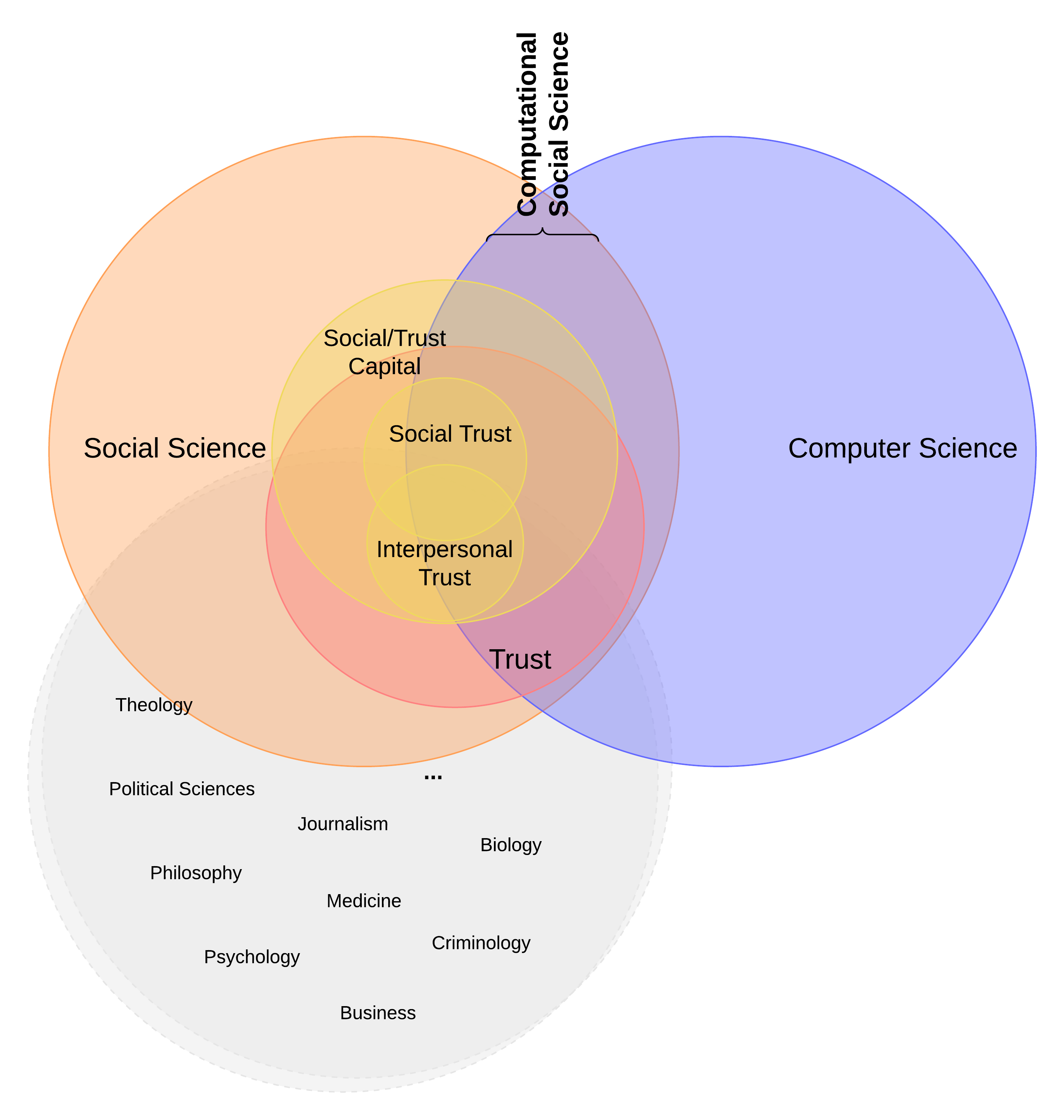
The opportunity came through collaboration between researchers at Birkbeck University of London and University of Palermo, studying childcare as a case study within Online Social Networks of Needs (OSNN)—a category I defined in my PhD thesis for interactions that start online, require significant trust (asymmetric, risk-taking), and evolve into in-person collaboration. Childcare represents one of the highest-trust scenarios within OSNNs, compared to platforms like Airbnb which require less interpersonal trust.
Instead of just analyzing network topology like most studies, we decided to test whether psychological models of trust could predict real-world outcomes better than traditional network metrics.
What we found challenges some common assumptions about how trust works in digital environments.
The Psychology vs. Network Science Experiment
The Setup
Most research on online trust focuses on network structure—who connects to whom, centrality measures, clustering coefficients. The assumption is that position in the network determines trust and success.
We took a different approach. Using the Castelfranchi-Falcone psychological trust model, we measured trust based on actual beliefs and competence assessments rather than just connection patterns.
The Castelfranchi-Falcone (CF-T) framework breaks trust into three core components:
- (a) Opportunity: The trustee’s practical ability to perform the action at a given time and location
- (b) Ability: The trustee’s competence and capability to perform the required action
- (c) Willingness: The trustee’s intention and disposition to actually perform the action
This represents a significant departure from network-based trust metrics. Rather than measuring trust through social graph position, CF-T evaluates trust as a multiplicative function of these three belief components—essentially asking whether someone has the opportunity, ability, and willingness to deliver on what they promise.
The Data
The childcare OSNN platform had rich data: families looking for childcare, nannies offering services, detailed profiles, reviews, and most importantly—actual hiring outcomes. We could see not just who connected with whom, but who successfully matched and collaborated in this high-trust environment.
This gave us something rare in network research: ground truth about whether trust predictions actually led to real-world outcomes.
What We Discovered
Psychological Models Won
The biggest surprise was how much better psychological trust models performed compared to traditional network metrics.
Network centrality measures (betweenness, closeness, eigenvector) that dominate social network research weren’t great predictors of successful collaborations. But when we modeled trust using psychological frameworks—measuring actual beliefs about competence and willingness—prediction accuracy improved significantly.
It turns out that what people believe about each other matters more than their position in a social graph. Which sounds obvious in hindsight, but isn’t how most recommendation systems work.
The Economic Correlation
The most unexpected finding was the correlation between regional trust levels and economic output. When we aggregated OSNN trust scores by geographic region and compared them with local GDP data, we found a 0.98 correlation.
Regions with higher average trust scores in the childcare network showed higher economic productivity. This suggests that digital trust behaviors might reflect broader social capital patterns that drive economic outcomes.
We’re not claiming causation—there are obvious confounding factors. But the strength of the correlation was striking and suggests digital trust metrics might be useful indicators for regional economic analysis.
Machine Learning for Matching
The psychological trust framework enabled more sophisticated matching algorithms. Instead of just recommending based on proximity or simple preference matching, we could predict compatibility based on trust dynamics.
Using fuzzy matching algorithms, we could match families with nannies based on complementary trust profiles and competence assessments, improving successful placement rates compared to traditional recommendation approaches.
Implications for How We Build Systems
Trust-Aware Design
Most platforms treat trust as a byproduct—something that emerges from repeated interactions or reputation scores. This research suggests that measuring and modeling trust explicitly, using psychological frameworks, might lead to better outcomes.
Instead of just tracking ratings and reviews, systems could assess beliefs about competence and willingness to help. The difference is subtle but important: it’s not just “do people like this person” but “do people believe this person can and will deliver what they promise.”
Regional Social Capital
The economic correlation suggests that digital platforms might be windows into broader social capital patterns. Trust behaviors in online communities could serve as real-time indicators of regional economic health or social cohesion.
This has implications for everything from economic policy to urban planning. Digital trust metrics might complement traditional economic indicators in interesting ways.
Beyond Network Effects
The dominance of psychological over topological predictors suggests that many network effect assumptions might be oversimplified. Position in a network matters less than the actual beliefs and assessments that drive trust relationships.
This doesn’t invalidate network science, but suggests that content—what people actually think about each other—might be more important than structure for predicting outcomes.
The Research Process
Academic Collaboration
Working with university researchers brought perspectives I wouldn’t have had in a purely industry context. Academic rigor in study design, statistical validation, and literature review complemented practical experience with platform design and user behavior.
The collaboration model worked well: researchers provided theoretical frameworks and validation methodology, while I contributed platform expertise and data analysis infrastructure. Different strengths, shared curiosity about how trust actually works.
Methodological Challenges
One challenge was adapting psychological assessment tools for platform data. Traditional trust research uses surveys and interviews, but we needed to infer trust beliefs from platform interactions and profile data.
We developed proxy measures—using profile completeness, response patterns, and review content to estimate trust dispositions and competence beliefs. Not perfect, but effective enough to show significant predictive differences.
Publication and Validation
The work went through peer review at ACM, which was educational in itself. Academic publication standards are different from industry research—more emphasis on theoretical grounding, replicability, and connection to existing literature.
The validation process improved the research significantly, forcing us to be more precise about claims and more thorough in testing alternative explanations.
Looking Forward
Broader Applications
The psychological trust framework could apply to many other platforms—freelancing networks, collaborative workspaces, social commerce. Anywhere that trust prediction matters for matching or recommendation.
The key insight is measuring beliefs about specific competencies rather than just general reputation or network position. More complex but potentially more accurate for predicting actual collaboration success.
Trust Infrastructure
There’s an opportunity to build trust assessment infrastructure that platforms could use. Instead of every platform reinventing trust measurement, shared frameworks based on psychological research could improve outcomes across different contexts.
Economic Research
The correlation between digital trust and economic output deserves deeper investigation. Could online community trust metrics serve as leading indicators for regional economic trends? Worth exploring with larger datasets and longer time series.
Reflections on Applied Research
This project reinforced how valuable it is to test assumptions with real data. Network science provides powerful tools, but the assumptions about what drives human behavior need empirical validation.
The collaboration between academic theory and platform practice worked well. Academic frameworks provided rigor and theoretical grounding, while platform data enabled testing at scale with real outcomes.
Most importantly, the research suggests that how we model trust in digital systems matters—and that psychology might have better answers than pure network science for predicting how people actually collaborate online.
The full research is available through ACM Digital Library for anyone interested in the detailed methodology and statistical analysis. Always curious about other applications or replications of this approach.